
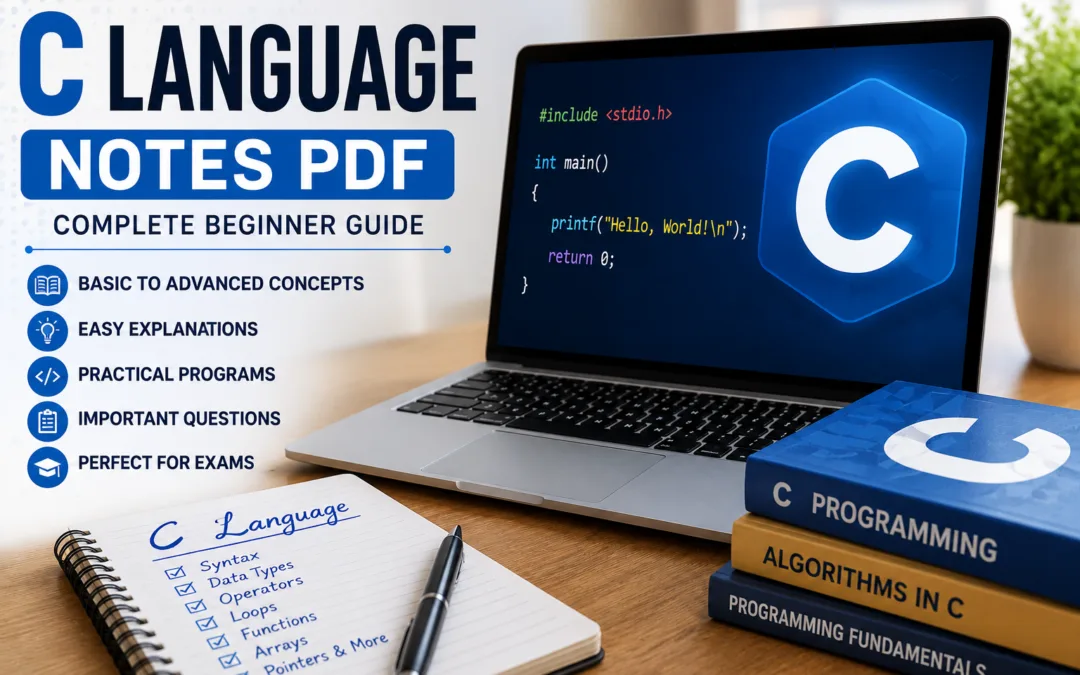
Are you searching for C Language Notes PDF for exams, coding practice, assignments, or revision? You are at the right place. We have created a complete beginner-friendly guide to C programming with theory, syntax, examples, practical programs, and important questions.
These notes are designed for school students, college beginners, and anyone who wants to learn C programming from scratch.
What is C Language?
C is a powerful and widely used programming language developed by Dennis Ritchie at Bell Labs.
It is known as the foundation of many modern programming languages and operating systems.
Why Learn C Programming?
- Builds strong programming basics
- Improves logical thinking
- Helps understand memory management
- Useful for software and system programming
- Makes learning other languages easier
Features of C Language
C programming has many important features that make it popular worldwide.
Main Features:
- Simple and easy syntax
- Fast execution speed
- Portable across systems
- Structured programming language
- Efficient memory usage
Topics Covered in These Notes
This PDF covers all important C programming concepts from beginner to intermediate level.
Included Topics:
- Introduction to C Language
- History and Features of C
- Structure of C Program
- Data Types in C
- Variables and Constants
- Input and Output Functions
- Operators in C
- Conditional Statements
- Loops in C
- Arrays and Strings
- Functions in C
- Pointers Basics
- File Handling
- Practical Programs
- MCQs and Viva Questions
- Revision Notes
First C Program
Hello World Program
#include <stdio.h>

int main()
{
    printf("Hello World");

    return 0;
}
Output:
Hello World
This is the first program most beginners learn in C programming.
Structure of a C Program
Every C program contains important parts:
Main Components:
- Header files
main()function- Statements
- Functions
return 0;statement
Understanding program structure helps students write correct and organized code.
Variables and Data Types in C
Variables are used to store data values in programs.
Common Data Types:
| Data Type | Example |
|---|---|
int |
Integer values |
float |
Decimal numbers |
char |
Single character |
double |
Large decimal values |
Example:
int age = 18;
float marks = 92.5;
char grade = 'A';
Operators in C
Operators perform operations on variables and values.
Types of Operators:
- Arithmetic operators
- Relational operators
- Logical operators
- Assignment operators
- Increment and decrement operators
Example:
int sum = a + b;
Loops in C
Loops are used to repeat statements multiple times.
Types of Loops:
forloopwhileloopdo whileloop
Example:
for(int i=1; i<=5; i++)
{
    printf("%d", i);
}
Conditional Statements
Conditional statements help programs make decisions.
Common Conditions:
ifstatementif elsestatementswitchstatement
Example:
if(number % 2 == 0)
{
    printf("Even Number");
}
else
{
    printf("Odd Number");
}
Important C Programs Included
This PDF includes practical programs such as:
- Addition of two numbers
- Even or odd number
- Prime number check
- Factorial program
- Fibonacci series
- Largest of three numbers
- Reverse number
- Multiplication table
These programs improve coding skills and logical thinking.
Download C Language Notes PDF
👉 Click below to download the complete beginner-friendly C Language Notes PDF:
Benefits of These Notes
- Easy explanations for beginners
- Includes theory and practical programs
- Helpful for exams and viva
- Covers important syntax and concepts
- Printable and student-friendly format
- Useful for quick revision
Who Should Use These Notes?
These notes are ideal for:
- School students
- College beginners
- Computer science students
- Programming learners
- Anyone learning C language
Tips to Learn C Programming Faster
Practice Daily
Write small programs regularly.
Focus on Syntax
Pay attention to semicolons and brackets.
Understand Logic
Learn how programs work step by step.
Debug Errors
Try to fix mistakes yourself for better learning.
Common Mistakes Beginners Make
- Missing semicolons
; - Incorrect variable declarations
- Wrong format specifiers
- Syntax errors in loops
- Forgetting header files
Quick Revision Notes
- C is a structured programming language
main()is the starting point of executionprintf()displays outputscanf()takes input- Loops repeat tasks
- Conditions help in decision-making
Final Words
C programming is one of the best languages to start learning coding. It helps students build strong programming fundamentals and prepares them for advanced technologies.
Download the complete C Language Notes PDF now and start learning programming today
More Study Material
Stay connected for more:
- Python Notes PDF
- Java Programming Notes
- HTML and CSS Guides
- MCQs and Question Papers
- Coding Practice Programs